Youth Education Mapping Using Geographically Weighted Regression
Labma Scientific Fair
2023
Background
This project was developed for a competition and is grounded in the real issues highlighted in national statistical research. Indonesia continues to face persistent poverty challenges, with more than 25 million people living below the poverty line. Research shows that youth education and digital access play a key role in shaping socioeconomic outcomes, especially in provinces with limited infrastructure. Motivated by these findings, this project investigates how the educational conditions of young people across Indonesian provinces influence poverty levels. By incorporating spatial modeling, the study aims to provide a more accurate and region-specific understanding of the relationship between education and poverty.
Responsibilities
I served as the team leader, responsible for coordinating task distribution, guiding the research direction, and ensuring smooth collaboration among team members. My role included managing the data processing and exploratory analysis to model development. I also led the interpretation of results and supervised the overall quality of the project deliverables to ensure that the final output met competition standards.
Key Features
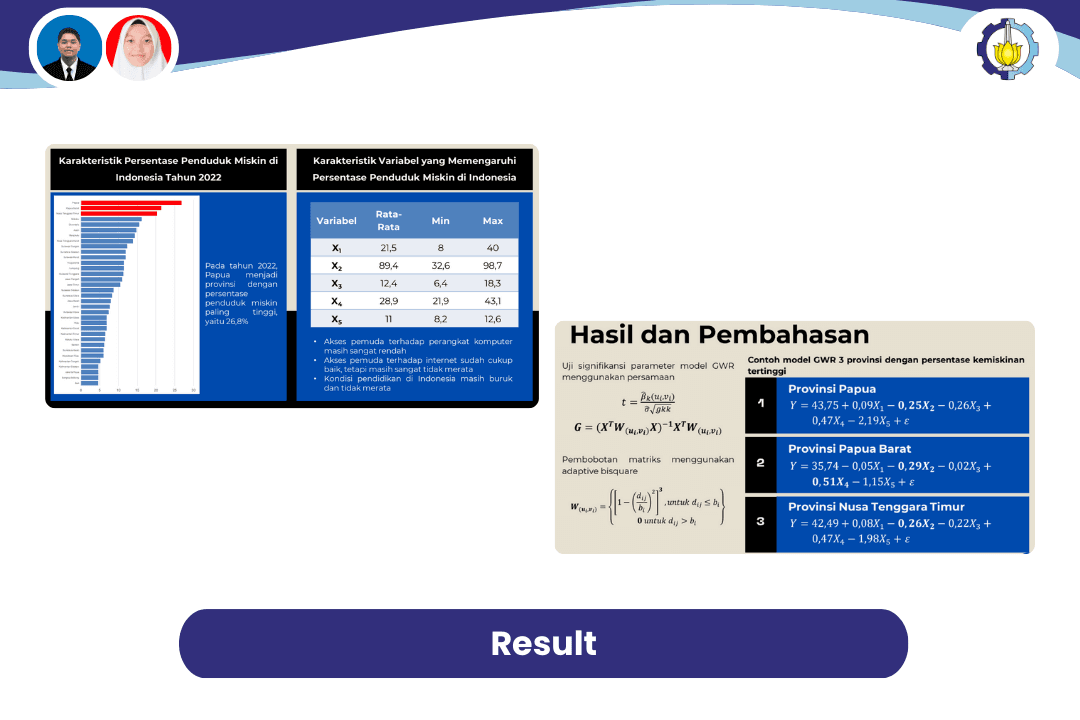
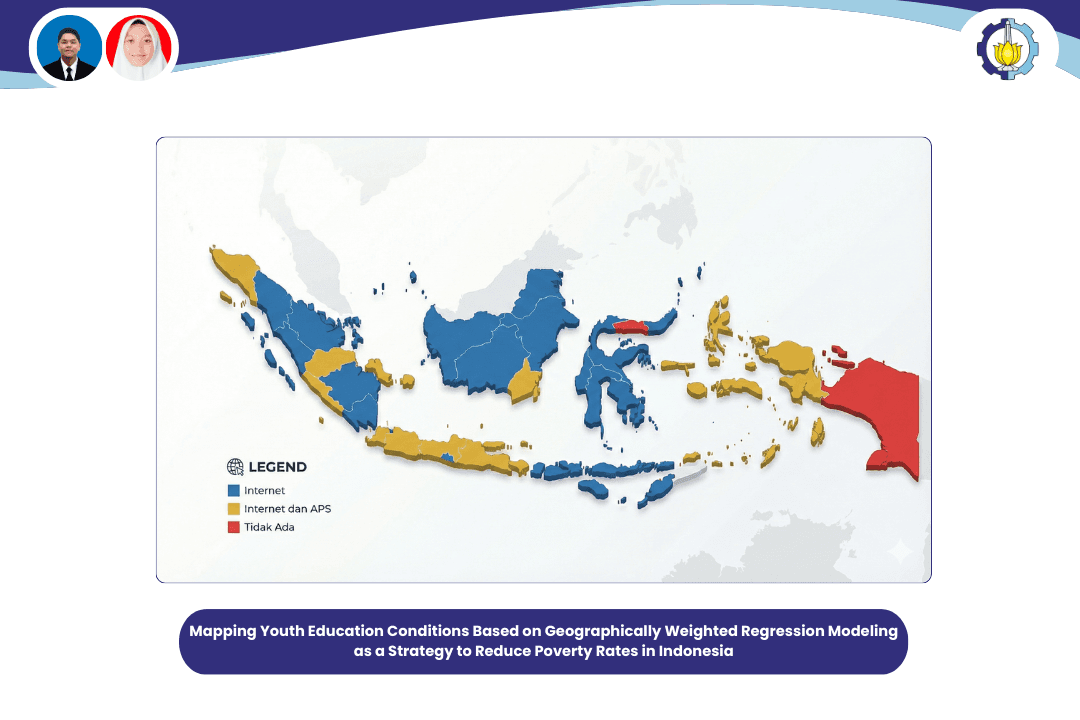
The project applies the Geographically Weighted Regression (GWR) method, a spatial modeling approach that allows coefficients to vary across locations instead of relying on a single global model. This technique helps reveal how the influence of youth education factors such as internet access, school participation rates, and average years of schooling differs between provinces. The model achieved strong explanatory power, showing that youth internet access and school participation rate are the most consistent predictors of provincial poverty levels. The spatial maps produced highlight clear disparities between western and eastern Indonesia, supporting the need for region-specific strategies.
Result
The project found that improving youth access to digital technology and increasing school participation have strong potential to reduce poverty in many provinces, particularly in eastern Indonesia where educational gaps are most severe. The findings emphasize the importance of targeted policymaking that considers regional characteristics rather than applying uniform national strategies. As a recommendation, provincial governments should prioritize investments in digital infrastructure, youth learning facilities, and programs that strengthen educational continuity. The project demonstrates how spatial modeling can guide more effective, data-driven interventions for poverty reduction.